By now, we’re all coming across AI in our daily lives. It’s visible in the titles in our news feeds, our kids’ school assignments, our medical care– even a quick scroll through our phones gives us multiple options to use AI if we choose to play along (and is present even if we don’t). As an artist, I’ve seen it pop up in a couple of interesting places: AI-generated or enhanced works, and artwork descriptions.
I appreciate that on Pinterest, AI-influenced art is noted on the work. However, even on sites where it’s not, it can still be recognizable. My kids make a regular practice of mistrusting photos in ads or news stories, often assuming they are “fake” or AI-generated because they look too polished or generic. A picture can have beautiful color, unique scenery, pristine lines, and still leave us cold. Why is that?
After realizing I was no longer enjoying Redbubble, I began looking for another website to post artwork for prints. I’ve been slowly adding my work on Fine Art America, and have had a bit of fun with leaving the AI-generated descriptions on my art after I upload it. I thought maybe it would help with keywords (if there’s one thing I loathe and dread about uploading artwork on any website, it’s the tedious task of tagging it with keywords).
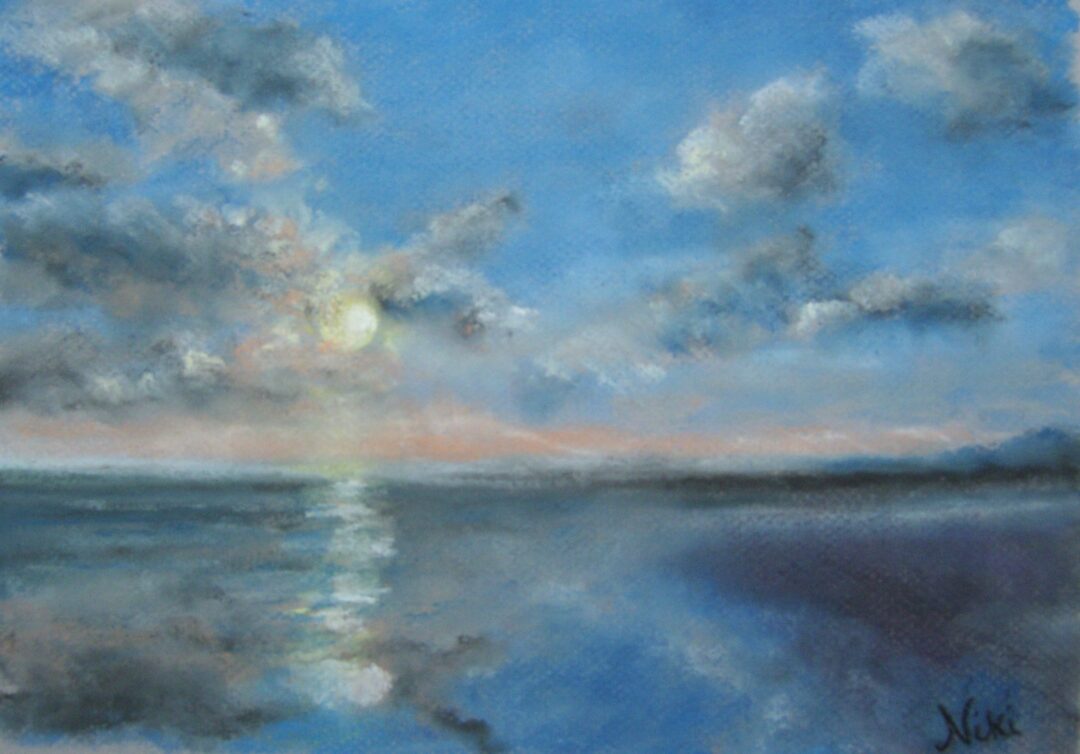
The descriptions were generally well-written and certainly descriptive. However, after uploading the piece above (and its companion, “Soft Sunset II”), I realized that I’ll probably be editing my works to include my own words in the descriptions.
Why? Well for one thing, despite the title, the description labeled the second piece as a sunrise. I live on the West Coast, so the sun in that position over water has always evoked sunset for me, which brings a much different mood than sunrise. I remember the strange feeling I would get on my few trips to the East Coast as the sun rose over the water in the mornings.
I also felt I needed to add the location to the description. It’s a beach in Oceanside, California. Those are the hills of Camp Pendleton in the distance. Like many people who’ve grown up in this area, the beach at Oceanside Harbor is the first beach I can remember visiting, and I still spend hours there on a regular basis. When I share this piece, I’m sharing the connection I have to this place, like so many other people who visit it probably have.
To a technological device, a beach is a beach. The sun in a particular position is a sunset or sunrise, depending on the time of day. The scattered clouds and light are “picturesque,” “tranquil.” “dreamy,” etc. But can the AI evoke the sounds of a beach sunset like a memory can? The swooping birds, rushing waves, laughing children, and occasional blare of the distant foghorn? One day it probably will. What about memories tied to a particular artwork I’ve created? The hours watching boats bobbing in the distance or surfers waiting for the perfect wave? The exhaustion of trudging through the hot sand with all my belongings, or the sweet memories of epic naps my babies have taken in my arms at this place?
I just read an email promoting a piece of artwork, and for the first time could tell the gallery’s description of the artwork was an AI-generated paragraph. It left a sour taste in my mouth as I read it. The hours the artist had put in to creating the mood and play of light and color in the scene disappeared in the generic words of the description. I re-focused on the painting itself, and figured that was a better way to appreciate the artist’s intention. AI descriptions might not harm the artworks themselves, but I think in some cases they do detract from the enthusiasm a view might feel for for those artworks.
I’ll be happy to let AI generate those awful keywords for me so I can get my listings up, but I’ll be going back and revisiting those descriptions for my art prints. In contrast to AI, artists bring authentic, unique experiences to their own creations. When combined with the way viewers interact with the expressions of those experiences, art provides intersections in our lives as humans that AI can’t replicate– at least for now.
When you create art, what experiences are you bringing to your works? When you view someone else’s art, what experiences are you bringing to your experiences as a viewer? Sounds, colors, scents, a memory of touch– each one of us has a unique collection of sensory experiences to access when we experience another artist’s creation. I believe this is why we take so much more from human-to-human art interactions than those we have with technology.
While you’re here, come check out my gallery over on Fine Art America! See if you can spot the AI descriptions I’ve left on some of my works: